上海交通大学医学院附属仁济医院消化内科房静远教授、陈萦晅教授和王争教授及其同事在Gastroenterology杂志(IF 22.67)上在线发表了一项重要的创新性研究的结果,该研究发现了可以用于胃癌筛查和早期预警的非侵入性、敏感和准确的粪便特征。

研究所确定的胃癌筛查和早期预警的粪便标志物为粪便中咽颊链球菌(Streptococcus anginosus, Sa)和星座链球菌(Streptococcus constellatus, Sc)。仁济医院消化科周澄蓓医师、潘思远博士,解放军总医院第七医学中心消化内科金鹏主任医师也是该项研究的主要研究者。
研究是基于什么样的背景?
胃癌是世界范围内发病率极高的恶性肿瘤之一,亚洲国家发病率明显高于欧美国家,以东亚地区发病率最高;而我国是胃癌的高发国家之一,全世界约一半的新发病例和死亡病例均发生在中国,位居国民消化道肿瘤发病率的首位,恶性肿瘤的第二位,死亡率居第三位。但由于胃癌早期缺乏典型临床表现,大部分患者就诊发现时就已发展至中晚期,导致胃癌患者死亡率升高、生活质量下降的同时,也成为家庭及社会的一大负担。
因此,降低我国胃癌发病率和死亡率是亟待解决的重大公共健康问题,胃癌早期筛查和早期诊断已被公认为能够有效降低胃癌发病率和死亡率的重要手段。但是目前,常用的胃癌筛查策略为血清学指标+胃镜精查及活检,仍为侵入性检查,急需应用便利、接受度更高的无创性生物标志物。
本研究的目的就是探索可用于预警胃癌和癌前病变的无创性生物标志物。
研究是如何进行的呢?
科学家们发现,在众多癌组织样品中,都能发现Sa的身影。受此启发,房静远教授团队尝试探索Sa及Sc作为胃癌及筛查标志物的可行性!
第一步:小规模探索队列
房教授团队首先聚焦于25位胃癌(GCa)和25位胃炎(ChG)志愿者的组织样品。通过16S rRNA目标基因测序,团队发现胃癌组中Sa的序列比例远高于胃炎组(P=0.0006)。
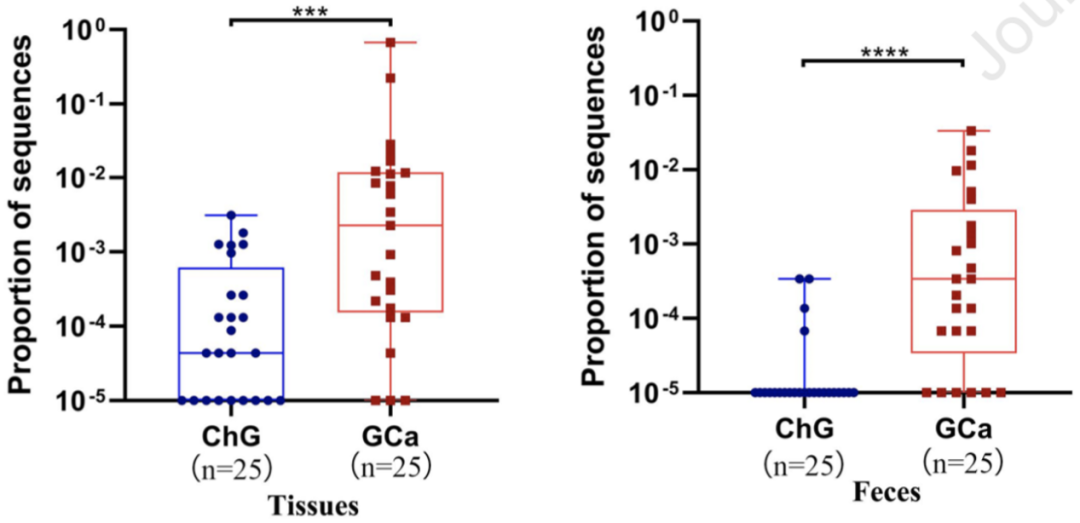
Sa丰度在胃癌和胃炎组中的差异,左图表示组织样品,右图表示粪便样品
无独有偶,团队成员用同样的方法分析同批志愿者的粪便样品后,发现Sa的序列在胃癌组中的比例也同样高于胃炎组(P<0.0001)。同样,Sc的序列也展现出相似的规律,在胃癌组中的比例显著高于胃炎组(组织:P=0.005;粪便:P=0.013)。
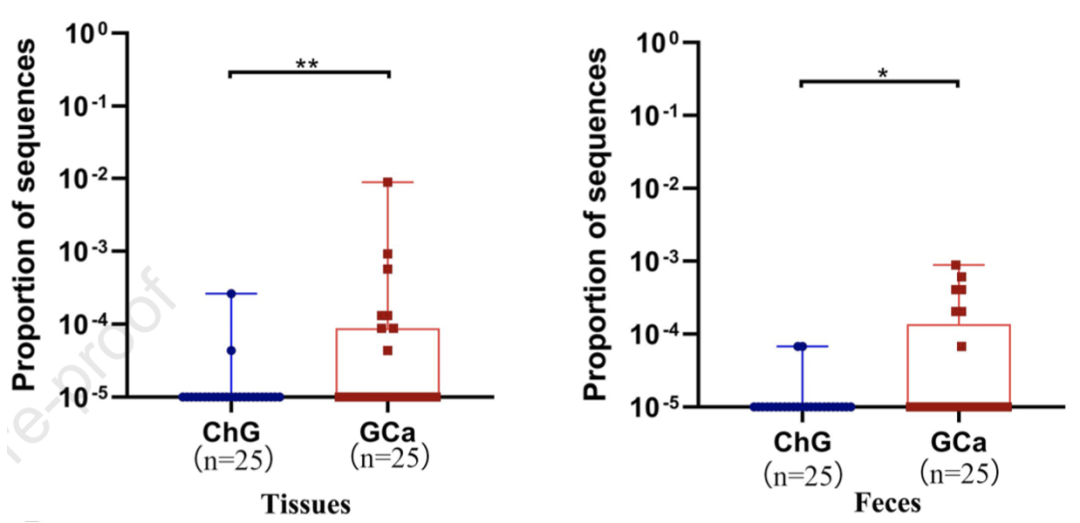
Sc丰度在胃癌和胃炎组中的差异,左图表示组织样品,右图表示粪便样品
Sa和Sc都是兼性厌氧细菌,有着相似的基因组,也都是人体条件致病菌。研究数据提示:无论是在胃癌患者的粪便样品还是在组织中,Sa与Sc都高度富集,二者在胃癌组织中的丰度呈高度正相关。
第二步:扩大测试队列
但房教授团队的研究脚步并未停止。为了继续探索Sa与Sc的可行性,房教授团队扩大研究规模,招募了510位志愿者,其中包括早期胃癌51人、进展期胃癌243人、胃炎组216人,采用qPCR技术,在组织和粪便样品中特异性扩增Sa和Sc的特征DNA序列。
令人振奋的是,研究人员再次得到类似的结果:胃癌组中Sa的相对丰度显著高于胃炎组(组织:P=0.013;粪便:P<0.0001);Sc在胃癌组中的相对丰度也显著高于胃炎组(组织:P=0.001;粪便:P<0.0001)。这些结果充分表明,Sa和Sc在胃癌患者肿瘤组织和粪便中富集,并且在粪便中的富集信号比组织样品强,且与胃炎组的测序结果相比,差异更明显。
既然Sa和Sc的水平变化在胃癌患者具有意义,那么,在早期胃癌患者中是否也是如此呢?
研究人员按照胃癌的进展阶段,将志愿者分成三组:胃炎、早期胃癌和进展期胃癌,随后发现Sa和Sc的水平在早期胃癌组中最高,且显著高于胃炎组(组织:P<0.0001;粪便:P<0.0001)。
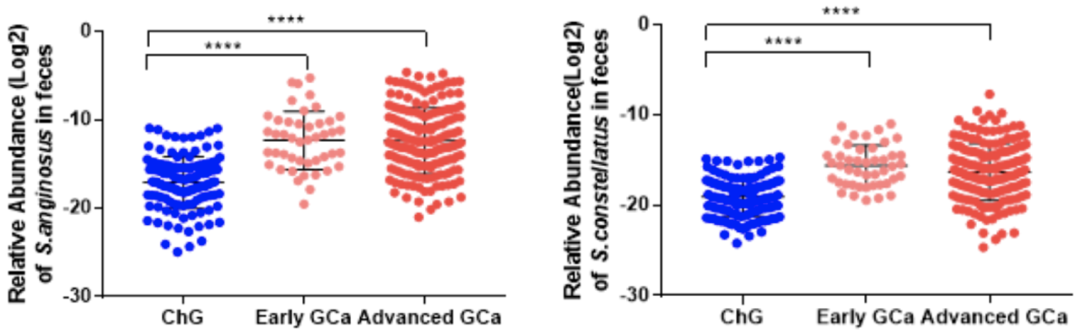
Sa(左图)和Sc(右图)的丰度在胃炎、早期胃癌和进展期胃癌志愿者中的分布
这意味着:Sa和Sc的水平能用于胃癌的早期预警。
为了探究粪便Sa和Sc水平对胃癌的辨识效果。在早期胃癌的判定中,Sa和Sc对早期胃癌的判定敏感性分别是75.6%和84.4%。值得注意的是,两者平行检验(如果两个信号中有一个阳性,结果呈阳性;如果两个信号都是阴性,结果呈阴性)敏感性高达91.1%(特异性64%);在进展期胃癌的判定中,粪便Sa和Sc的平行检验也获得最佳效果,敏感性81.4%(特异性73.4%)。
第三步:验证队列
最后,为了验证以上结果的可靠性,房教授团队再次招募了483名受试者作为验证人群,其中胃炎组227人、早期胃癌组100人、进展期胃癌组113人。受试者来自北京、天津、南京、上海、厦门和广州的10家医院,具有广泛的代表性。
结果显示在验证人群中,胃癌组的粪便Sa和Sc水平都显著高于胃炎组(P<0.0001)。与测试人群一致的是,Sa和Sc的平行检验对早期胃癌的预测能力最好,敏感性达到97.6%;即使加入判定模型CEA后,敏感性(97.3%)并没有得到提升。对进展期胃癌的预测中,Sa和Sc的平行检验敏感性达到92.1%。
结论
粪便Sa和Sc是胃癌早期预警的非侵入性、准确和敏感的生物标志物。该研究揭示了粪便微生物在胃癌早筛中的潜能,为消化道恶性肿瘤的筛查提供了新思路,也将推动粪便微生物在疾病早筛中的应用。
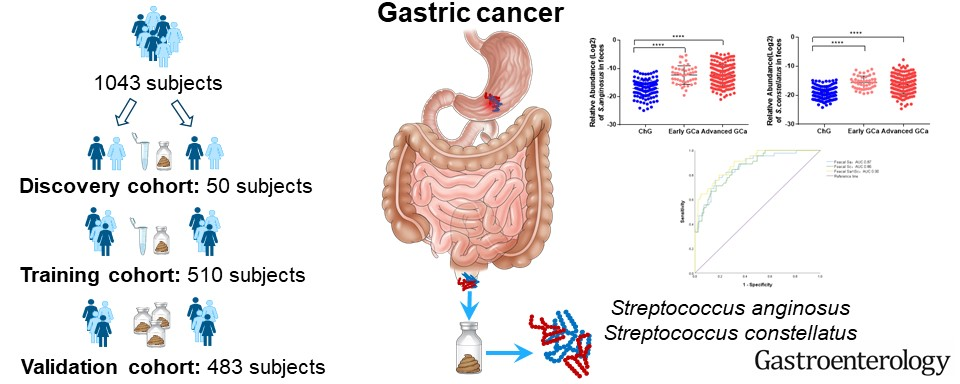
以下为研究摘要部分:
Fecal signatures of Streptococcus anginosus and Streptococcus constellatus for non-invasive screening and early warning of gastric cancer
Cheng-Bei Zhou#, Si-Yuan Pan#, Peng Jin#, Jia-Wen Deng, Jin-Hui Xue, Xin-Yue Ma, Yuan-Hong Xie, Hui Cao, Qiang Liu, Wei-Fen Xie, Xiao-Ping Zou, Jian-Qiu Sheng, Bang-Mao Wang, Hong Wang, Jian-Lin Ren, Si-De Liu, Yun-Wei Sun, Xiang-Jun Meng, Gang Zhao, Jin-Xian Chen, Yun Cui, Pei-Qin Wang, Hui-Min Guo, Lang Yang, Xin Chen, Jia Ding, Xiao-Ning Yang, Xin-Ke Wang, Ai-Hua Qian, Li-Dan Hou, Zheng Wang*, Ying-Xuan Chen*, Jing-Yuan Fang*. / Gastroenterology / 2022-02-12 online published
Professor Jing-Yuan Fang, Ying-Xuan Chen and Zheng Wang of Renji Hospital, School of Medicine, Shanghai Jiao Tong University, and their colleagues published an important study online in the journal Gastroenterology (IF 22.67) about a innovative study which reported non-invasive, sensitive and accurate fecal signatures in screening and early-warning of gastric cancer.
The study introduced novel, non-invasive and sensitive fecal signatures of Streptocccus anginosus and Streptococcus constellatus in screening and early-warning of gastric cancer and was published in 《Gastroenterology》(Zhou CB, Pan SY, Jin P, et al. Fecal signatures of Streptococcus anginosus and Streptococcus constellatus for non-invasive screening and early warning of gastric cancer [published online ahead of print, 2022 Feb 12]. Gastroenterology. 2022; S0016-5085 (22) 00143-3. doi: 10.1053/j.gastro.2022.02.015). Cheng-Bei Zhou, Si-Yuan Pan of Renji Hospital, School of Medicine, Shanghai Jiao Tong University and Peng Jin of The First Medical Center of Chinese People’s Liberation Army General Hospital are contributed equally to this work.
Abstract:
Background & Aims: Most patients with gastric cancer (GCa) are diagnosed at an advanced stage. We aimed to investigate novel fecal signatures for clinical application in early diagnosis of GCa.
Methods: This was an observational study that included 1,043 patients from ten hospitals in China. In the discovery cohort, 16S rRNA gene analysis was performed in paired samples (tissues, feces) from patients with GCa and chronic gastritis (ChG) to determine differential abundant microbes. Their relative abundances were detected using qPCR to test them as bacterial candidates in the training cohort. Their diagnostic efficacy was validated in the validation cohort.
Results: Significant enrichments of Streptococcus anginosus (Sa) and Streptococcus constellatus (Sc) in GCa tumor tissues (P < 0.05) and feces (P < 0.0001) were observed in patients with intraepithelial neoplasia and early and advanced GCa. Either the signature parallel test Sa∪Sc or single signature Sa/Sc demonstrated superior sensitivity (Sa: 75.6% vs. 72.1%, P<0.05; Sc: 84.4% vs. 64.0%, P<0.001; Sa∪Sc:91.1% vs. 81.4%, P<0.01) in detecting early GCa compared with advanced GCa (specificity: Sa: 84.0% vs. 83.9%; Sc: 70.4% vs. 82.3%; Sa∪Sc:64.0% vs. 73.4%). Fecal signature Sa∪Sc outperformed Sa∪CEA/Sc∪CEA in the discrimination of advanced GCa (sensitivity: 81.4% vs.74.2%; 81.4% vs.72.3%, P<0.01; specificity: 73.4% vs.81.0 %; 73.4% vs. 81.0%). The performance of Sa∪Sc in the diagnosis of
both early and advanced GCa was verified in the validation cohort.
Conclusion: Fecal Sa and Sc are non-invasive, accurate and sensitive signatures for early warning in GCa.
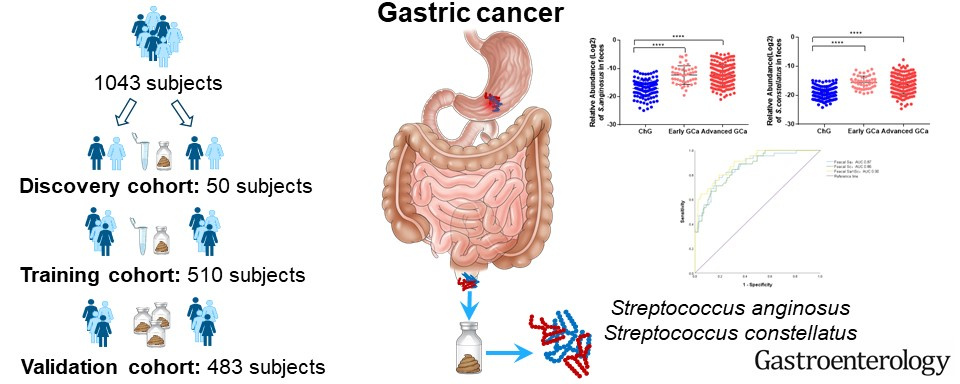
Figure: In this study, altogether 1043 subjects were included and three cohorts were established to explore and validate the diagnostic performance of two significant fecal signatures Streptococcus anginosus and Streptococcus constellatus.
欢迎投稿!
稿件以word文档发送至邮箱:
xheditor@126.com
分享实践经验,记录医学故事,传播学术进展。